San Adolfo · Huila, Colombia
The Lasso Family: Resilience, Reinvention, and the Pursuit of Flavour


From Crisis to Continuity: Segundo’s Resolve
The Lasso story begins with Segundo Lasso, a farmer in San Adolfo, Huila, who came of age during Colombia’s coffee crisis. In the late 1990s and early 2000s, international prices plummeted, and smallholder families across the country were forced to abandon their farms. For Segundo, the choice was stark: walk away, or dig in. He chose to stay.
With little financial security but a deep connection to the land, Segundo replanted trees, rebuilt soil, and carried on when stability seemed impossible. That quiet persistence became the foundation of his family’s legacy. More than two decades later, his Pink Bourbon still reflects the same steady character: a clean, fruit-forward cup that tells the story of a farmer who refused to let go.
Segundo’s influence is evident not only in his own work but in the way he taught his children to read the land, care for trees, and carry forward knowledge. His decision to endure meant his sons had something to inherit — not just a farm, but a way of life.
Wilder’s Path: Science Meets Passion
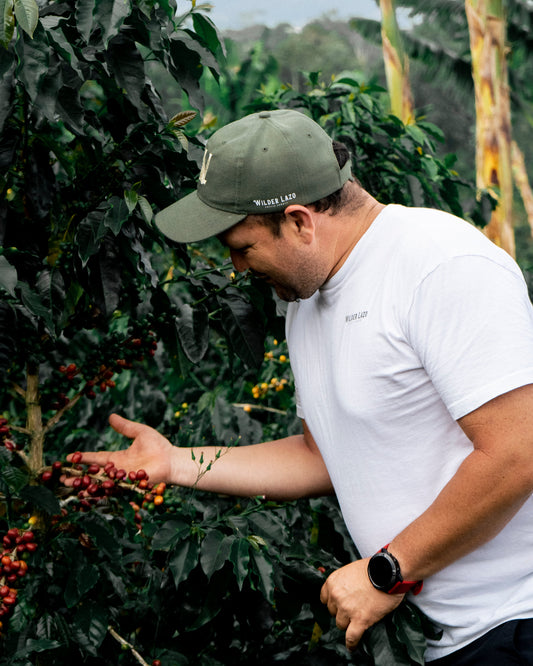
Where Segundo provided resilience, Wilder Lazo brought reinvention. Trained as a veterinarian, Wilder never intended to dedicate himself to coffee. But in 2019, he planted his first Gesha seedlings at his farm, Bella Alejandría, and quickly found himself captivated by the possibilities.
Wilder approaches coffee with a scientist’s mindset and a grower’s heart. He specialises in selecting Gesha phenotypes with exceptional size and floral clarity, combining agronomy with bioengineering to push flavour boundaries. His farms aren’t just fields — they are laboratories where science and tradition meet.
His commitment extends beyond cultivation. In 2023, Wilder travelled to London to host a cupping at Glass Coffee’s roastery, giving our community a rare opportunity to hear his story firsthand while tasting the results of his work. The event highlighted not just his innovation, but his openness — a willingness to share his methods, his challenges, and his vision for coffee’s future.
At Bella Alejandría, located nearly 1,950m above sea level, volcanic soils and cool mountain nights slow cherry maturation, intensifying sugars and aromas. Combined with Wilder’s meticulous selection and processing, the coffees are luminous: floral, lemongrass-driven, and precise.


Heiner’s Journey: Learning Through Loss
Heiner Lasso inherited his farm, Finca El Rubí, when he was just 18. At first, it seemed promising: healthy Caturra trees, reliable harvests, and a strong family foundation. But in 2003, coffee leaf rust tore through San Adolfo, devastating his crop and nearly ending his prospects.
Rather than walking away, Heiner enrolled at SENA, Colombia’s national learning institute, immersing himself in agronomy, pest control, sensory analysis, and specialty coffee. When it came time to replant, he didn’t choose the varieties most resistant to disease. Instead, he chose varieties that excited him: Gesha, Sidra, SL28, and Pink Bourbon.
Today, El Rubí sits between 1,750–1,850m, a small four-hectare farm that produces coffees marked by clarity and structure. His washed Pink Bourbon has become a cornerstone of Glass Coffee’s line-up, now in its third year with us. Lavender florals, cane sugar sweetness, and grapefruit acidity define the lot, but behind the flavour lies something deeper: Heiner’s refusal to give up, his choice to transform loss into learning.
Heiner still farms alongside his father and brother. While each manages his own land, they regularly return to the same table, sharing knowledge and strategies. “We work together,” Heiner says. “And it always ends up benefiting us all.”

San Adolfo: A Landscape of Extremes
The Lasso farms are all rooted in San Adolfo, in southern Huila — a landscape where altitude, soils, and climate create the perfect stage for specialty coffee. Perched above 1,800m, the region is defined by cool nights, misty mornings, and fertile volcanic soils. These conditions slow ripening, allowing sugars and aromatics to develop with precision.
Biodiversity is everywhere. Shade trees regulate temperature, protect against erosion, and foster microbial richness in the soil. The diurnal swings sharpen acidity while preserving sweetness. For varieties like Gesha and Pink Bourbon, San Adolfo offers a natural home — and in the hands of the Lasso family, that terroir is translated into expressive, distinctive lots.

Partnership With Glass Coffee: A Shared Table
Our relationship with the Lasso family runs deep. It is not just about transactions, but about values: transparency, community, and long-term stewardship. From Segundo’s persistence through hardship, to Wilder’s scientific innovation, to Heiner’s resilience and craft, each member of the family represents a different facet of what we believe coffee should be.
Hosting Wilder in London for a cupping was a milestone in our collaboration, giving our customers a direct connection to the farmer behind the cup. Working year after year with Heiner’s Pink Bourbon has given us — and our community — consistency, trust, and flavour we can rely on. And partnering with Segundo ties it all back to the roots, to the generation that endured so this one could innovate.
Together, the Lassos are more than individual producers. They are a family whose story spans decades, whose choices have shaped their land, and whose coffees carry forward both memory and invention.

A Generational Legacy in Every Cup
When you taste a Lasso coffee, you’re drinking more than Gesha or Pink Bourbon. You’re tasting Segundo’s quiet decision to persist when others left. You’re tasting Wilder’s bold marriage of science and passion. You’re tasting Heiner’s resilience in the face of loss, his refusal to stop learning.
At Glass Coffee, we are honoured to showcase their work. Every Lasso lot is a reminder that coffee is not just agriculture, but inheritance — a generational story of resilience, reinvention, and the pursuit of flavour.
Lasso Family Coffees
The Lasso family represent three generations of coffee farming in San Adolfo, Huila. From Segundo’s quiet persistence during Colombia’s coffee crisis, to Wilder’s scientific innovation with Gesha at Bella Alejandría, to Heiner’s meticulous Pink Bourbon at Finca El Rubí, their story is one of resilience, reinvention, and craft. Each member of the family brings a unique voice, yet together they embody the values we admire most: transparency, community, and long-term stewardship. Explore their coffees and discover a legacy expressed in every cup.
-
Wilder Lazo - Bella Alejandría · Gesha
Extended, Natural · San Adolfo, Huila, Colombia
Regular price From £12.85Regular priceUnit price per