David, Chiriquí, Panama
TNT Lab


A Panamanian processing lab built around control, patience and flavour
TNT Lab is a coffee processing laboratory based in David, in Panama’s Chiriquí province. It is not a farm. It is a facility built specifically to receive, ferment, dry and rest coffee cherries from partner producers across the region, with close control over temperature, timing and outcome at every stage.
TNT stands for Top Natural Taste. The name reflects a simple position at the centre of the project: TNT’s work is built around natural processing logic, without added essences or artificial flavour inputs. The “lab” matters too. This is not a loose experimental space. It is a working system designed to make post-harvest decisions more controlled, more legible and more repeatable.
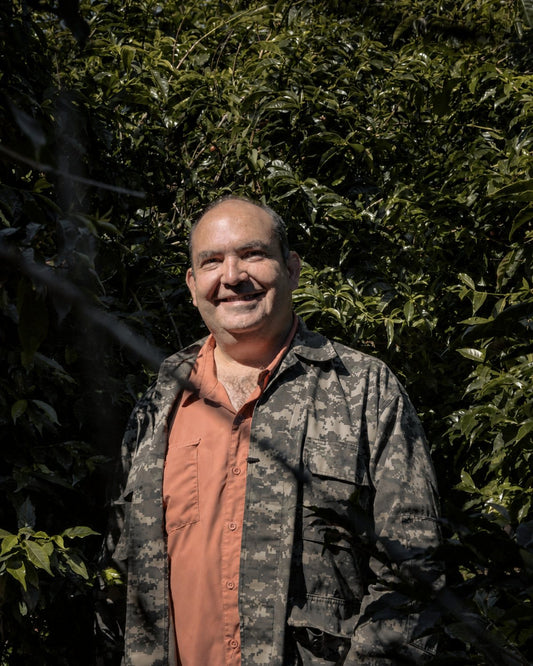
Publicly, Adrian Santiago is the clearest figure behind TNT Lab, having founded the project after years working with Panamanian farms and processing projects. Through our own conversations with TNT, we came to understand the wider operation, including the role Alfonso Cheung plays alongside the café and processing work in David.
How the project developed
Before TNT Lab existed as a formal operation, Adrian had already spent years working with Panamanian farms and processing projects. The lab grew out of a conviction shared by Adrian and Alfonso: post-harvest work could do more than preserve quality. Done well enough, it could clarify and elevate it.
The early strategy was deliberate. TNT initially worked with established farms such as Santamaria Estate Coffee and Finca Auromar. That matters because these were not anonymous starting points. Santamaria Estate Coffee, run by Edwin Santamaria in Paso Ancho, Chiriquí, was established in 1950 and placed third in the Geisha Natural category at Best of Panama 2017 with 93.031 points. Auromar, Roberto Brenes’s farm in Candela, Chiriquí, is one of Panama’s most recognised coffee estates and has taken top Best of Panama honours more than once.
That context makes TNT’s next move more interesting. After proving themselves with well-known farms, they began expanding towards a broader mix of producers and farm partners, including smaller or less internationally recognised names. The aim was not to move away from great farming, but to test a harder question: how much of the final result comes from the raw material, and how much comes from the processing itself?
The network now includes farms and producer partners such as Mamacata, Don Cheo, Feryen, Talamanca and Las Margaritas. Together, they reflect the wider direction of the project: applying disciplined post-harvest work across different farm contexts, terroirs and varieties, while continuing to refine TNT’s understanding of how process can shape, clarify and elevate the final cup.


How the lab works
TNT’s operation is built around one central principle: slow the process down so more of it can be controlled.
Coffee cherries begin fermenting as soon as they are picked, and heat accelerates that process. TNT manages this by coordinating picking times with partner farms, asking for cherries to be harvested later in the day so the window of uncontrolled early fermentation is shorter before the coffee reaches the lab. Cherries typically arrive in the evening. Processing begins at night, once temperatures drop. The team often works into the early hours of the morning.
From there, almost all coffees enter the cold room, held at 9°C. The minimum stay is four days. Different lots then follow different pathways depending on the intended process. Some are split into honey and natural versions. Some undergo extended cold fermentation. A process called Baby Bomb stays in the cold room for 30 days. Another, Polar Bear, ferments slowly as a natural before moving into a staged drying sequence. The point is not the name. It is the structure. Each process has a defined temperature profile, a defined timeline and a defined purpose.
TNT operates four drying stations with different heat intensities. Coffees with longer or more active fermentation are moved to the hottest greenhouse to stop fermentation quickly. Others are dried more gradually. After drying, lots rest in parchment for a minimum of two months before milling, and longer for more fermentation-heavy coffees. During that period, the team mills small samples and cups them every two weeks to track how the coffee is developing.
Quality control before export follows a three-stage process: an initial mechanical pass, then two rounds of manual sorting. In practice, that level of care shows up in the condition of the green coffee itself. When Glass roasted TNT’s Koji Geisha, the physical preparation was notably clean: very few quakers, consistent bean size, and a level of finish that matched the ambition of the processing.

How TNT thinks about quality
At the centre of TNT’s work is the relationship between terroir and process.
The lab does not dismiss altitude, variety or growing conditions. On the contrary, those variables remain foundational. But TNT’s view is that what happens after picking — how quickly fermentation is controlled, how temperature is managed, how drying is used, how patiently the coffee is rested — has a more decisive effect on the final cup than many people admit.
That belief is being tested in practice. By working with farms at different altitudes and with different levels of market recognition, TNT is building its own evidence for the idea that disciplined post-harvest work can reveal quality more clearly, and sometimes push it further than the market expects.
What makes the best TNT coffees distinctive is not simply intensity. It is that the cups can be highly expressive while still allowing terroir and variety to remain legible. The process is clearly doing important work, but it does not read as the whole story. That is part of what separates these coffees from more overtly process-led styles, where fermentation can dominate the identity of the cup.
Their Koji work is the clearest example. TNT built a dedicated room for it and developed the process through repeated trial and error across multiple harvest cycles. Because coffee cherries naturally contain very little starch, they use a light starch-based preparation to help the culture grow without pushing the coffee into over-fermentation. The aim is not simply to make the cup louder. It is to elevate sweetness while preserving the true character of the variety. That is a more difficult ambition, and it says a great deal about how the lab approaches flavour.

Glass and TNT
Glass first sourced TNT coffee through an importer. The cup quality was what drew our attention: expressive, precise and clearly shaped by process, but without losing the character of the variety underneath it.
What confirmed the relationship was a Google Meet with Alfonso during the 2026 harvest. He walked us through the facility in detail, showing the cold room, drying stations, African beds, dark rooms, Koji setup and the storage area where parchment rests before milling. He explained why they process at night, how they coordinate picking times with farms, how different fermentation lengths change the drying strategy, and why some coffees need much longer rest before they are ready to show their full character.
That level of openness mattered. Processing is one of the most overused and underexplained areas in specialty coffee. Here, the opposite was true. The more Alfonso explained, the clearer the system became. For Glass, that kind of transparency is not decorative. It is exactly what we look for.
Most of TNT’s client base has historically sat outside Europe, and their coffees are already appearing on roasters’ shelves in China, Korea and Canada and the United States. That makes this relationship meaningful for us in another way too: it brings a processing project with an established international presence into clearer view for a UK audience.

Why TNT matters
TNT Lab matters because it makes a strong case for taking post-harvest work more seriously.
The project does not argue against farming, altitude or variety. It depends on them. But it also shows how decisively the final quality of a coffee is shaped after picking: when the cherries are received, how quickly they are cooled, how carefully fermentation is controlled, how drying is used to stop or extend that fermentation, how patiently the coffee is rested, and how rigorously it is sorted before export.
We are excited to begin working more directly with TNT and to showcase their work across coffees from Panama. What gives us confidence is not only the cup quality, but the seriousness of the system behind it and the openness with which Adrian and Alfonso are willing to share it. Their project also helps make something else clearer: how strong Panamanian coffee can be when exceptional terroir, careful farming and disciplined processing are allowed to work together.