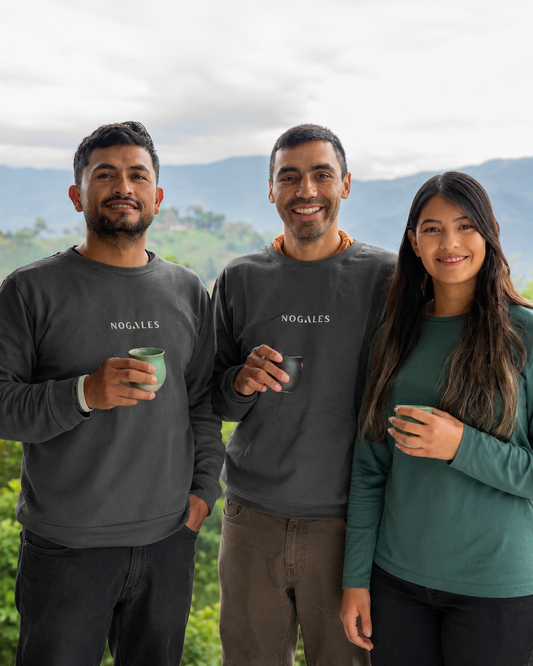
El Diamante · Pitalito, Huila, Colombia
Nogales


We’re proud to feature Finca Nogales: a family-run research farm in El Diamante, Pitalito, Huila. Led by Oscar Hernandez with technical direction from Anibal and Angie, the farm pairs selective, hands-on harvesting with lab-driven experiments (microbiology, thermal-shock protocols and controlled ferments) to produce clean, repeatable, award-calibre lots. Nogales is artisan at scale: small-lot care, rigorous data, and a clear focus on community and traceability - coffees that consistently push what Huila can deliver.


Innovation rooted in family and place
Tucked into the misty slopes of El Diamante in Pitalito, Huila, Finca Nogales reads like a classic Andean estate until you look closer. Native shade trees, steep terraces and selective picking define the landscape, but the infrastructure tells the deeper story. A cupping lab equipped with a ROEST sample roaster and EK43 grinder sits alongside a working microbiology lab and a data system that ties each lot to its plot, fermentation protocol and cupping results. The setting is rural, but the approach is disciplined and highly technical. That contrast is not a branding exercise. It is how the farm is run.
Finca Nogales is one of the most thoughtful and technically driven farms we work with at Glass. Here, the fifth generation of the Hernandez family has taken inherited land and a difficult history and built something structured and forward-looking. Innovation at Nogales is not about chasing extremes. It is about building repeatable processes that keep improving cup clarity and consistency, season after season, while staying grounded in the realities of a hillside farm. Their work shows range, confidence and intent, with choices that can be traced from agronomy and soil management, through fermentation design and microbiology, and into sensory evaluation.
What follows is a profile of Finca Nogales itself: the people behind it, the landscape they work in, and the systems they have built to keep refining what Colombian coffee can be.

Roots: The Legacy Of Ricaurte Hernandez
The story of Finca Nogales begins in the early 1950s, when Ricardo Hernández and Concepción Castillo arrived from Nariño to the then emerging district of Bruselas. They settled on fertile land above Pitalito that would later become El Diamante, planted the first coffee trees, and raised eight children who grew up with coffee as both work and identity.
Among those children, the youngest son, Ricaurte, stands out in every version of the farm’s history. A farmer by profession and by conviction, he refused to accept coffee as a subsistence crop with no upside. He wanted Nogales to be profitable and professional, but also to provide dignified employment and real educational opportunity for the people around it. In his view, quality was not a luxury. It was a route to stability.
In 2005, that vision reached a wider audience. Colombia hosted its first Cup of Excellence competition and more than 280 lots were submitted. Under Ricaurte’s leadership, Nogales took first place. International judges ranked its coffee above every other entry, and the win became a reference point not only for the farm but for Huila and for Colombia more broadly. As Oscar would later describe it, the result drew a line in the national story of specialty coffee.
Ricaurte did not stop at scores. He pushed for better soil management, new ways of processing, and different commercial models that gave farmers more control and more value at origin. The foundations of today’s Nogales are already visible in his approach: invest in knowledge, build systems around people, and treat innovation as a responsibility rather than a marketing claim.

Loss, Return And Reinvention
The next chapter is painful. In February 2013, while travelling to the farm, Ricaurte was killed by armed groups. It is a story that echoes across rural Colombia, where violence has repeatedly cut short lives and projects that were only beginning to take shape. In the aftermath, the Hernández family considered selling the farm, both to protect their mother and to step away from a place now tied to grief.
At that moment, Oscar Fernando chose a different path. Trained as an industrial engineer and serving as a non-commissioned officer in the Colombian Navy, he left his military career and returned home to take responsibility for Nogales. For him, the most faithful way to honour his father was not to preserve the farm as a memory, but to keep building it as a living project.

Oscar brought discipline, systems thinking and environmental training. His studies in environmental management at SENA sharpened his focus on sustainable production and the reuse of materials. The Navy had taught him logistics, leadership and structure under pressure. At Nogales, those threads came together. Under his direction, the farm shifted from a traditional estate into a research-led operation where process design and measurement sit alongside yields.
The aim is explicit: build a business that is profitable, pays well, creates stable work, and encourages people to keep studying without having to leave the countryside behind. Nogales becomes a vehicle for quality coffee, but also for a broader idea of what a farm can be when it treats experimentation, education and community as part of its core operating system.

From Farm To Research Hub
Nogales today operates as an integrated system of land, people, infrastructure and experimentation.
The core farm spans roughly 22 hectares, with around 63,000 trees planted up to 2,100 metres above sea level under native shade. Eighteen varieties are in active production, including Geisha, Caturra, Colombia, Cenicafé selections, yellow and pink Bourbon, Tabi, Hava, Typica and Bourbon Pimenta. Each variety is treated as a separate project, with defined processing goals rather than a single, uniform approach.
In recent years, the family added a second property, Niebla, after searching for higher elevations and specific climatic conditions. Reaching approximately 2,150 metres above sea level, Niebla is planted with varieties such as Panama Geisha and Typica Mejorado, intended for the most delicate and high-definition profiles. Dry milling is managed through a custom-built facility at origin, allowing the family to oversee the full chain from cherry to export-ready lot.
The physical layout tells only part of the story. The other half lies in structure and defined roles.
A microbiology lab, led by chemist Karen Carrillo, isolates and cultivates native microbial cultures for controlled fermentations. Sanitary protocols and monitoring systems are designed to reduce risk and improve repeatability.
The cupping laboratory, headed by Aníbal Díaz, evaluates every lot and every experimental protocol. Using a ROEST sample roaster and Mahlkönig EK43 grinder, the team logs results into Cropster and ties sensory data back to specific plots, varieties and fermentation variables.
Drying is coordinated by Nelson Muñoz, who manages multiple drying areas and ensures each batch reaches target moisture and water activity levels. No coffee moves forward without passing through these checkpoints.
Lots that meet strict profile parameters are released individually. Coffees that fall outside target profiles but still cup well are blended into a house Nogales blend. This allows the farm to maintain standards without discarding quality material, and gives buyers an alternative to generic regional blends.
The overall model is disciplined but not rigid. Small-lot fieldwork and patio drying remain hands-on. What has changed is the layer of measurement and feedback that now surrounds them.

The People Behind The Processes
Finca Nogales remains, at its core, a family-led operation with defined leadership roles.
Oscar serves as CEO and strategic lead, responsible for long-term direction and operational structure.
Angie Hernandez, trained as an industrial engineer, leads operations and plays a central role in fermentation design and microbiology. Her work has helped formalise the use of thermal shock, pre-ferments and extended fermentations in ways that prioritise clarity over extremity.
Anibal Diaz oversees the sensory programme. He defines cup profiles, evaluates research fermentations, and designs roast curves that translate processing decisions into coherent flavour expression. Together, Oscar and Anibal determine which protocols remain experimental and which move into standard production.
Around them is a wider team covering finance, creative direction, plant management and information systems. Traceability infrastructure is not an afterthought but a core function. Seasonal picking families form the backbone of the harvest, and each year they are trained on ripeness standards, handling protocols and quality awareness so they understand the impact of their work on the final cup.
Even the organisational chart includes humour. The farm dogs are given titles, reflecting a culture that takes work seriously without becoming sterile. It signals something important: Nogales sees itself not as a factory, but as a living environment with defined roles and shared responsibility.

Soil, Organic Matter And Microbiology
One of the most consistent threads in Nogales’ work is the focus on soil health. The family speaks about coffee plants as long-term assets, and that perspective shapes how the land is managed.
The process begins in the nursery, with careful seed selection and controlled early growth. Once planted, trees are supported through a fertilisation strategy that prioritises organic matter and microbial life. Coffee pulp, prunings and other residues are composted and returned to the soil. The objective is to feed soil biology first, strengthen root systems, and build resilience that translates into more stable flavour expression.
Microbiology plays a defined role in this system. Pre-ferments are developed from native yeasts and bacteria isolated on the farm. These cultures are monitored, cultivated and then introduced into fermentation tanks to guide flavour development and reduce the risk of unwanted microbial activity. The intention is control, not novelty.
In washed and honey processes, thermal shock is often used as part of a broader sanitation and fermentation strategy. Cherries are exposed to hot water, typically around 80°C, then rapidly cooled to approximately 15°C. This shift helps reduce surface microbial load and prepares the beans for controlled fermentation. Sugars extracted from fresh husks may be reintroduced to support microbial activity, and fermentations often extend to around 120 hours depending on variety and desired profile.
A typical framework includes:
· Selective harvesting of fully ripe cherries
· Cleaning and disinfection with treated water
· Density sorting to remove floaters
· Thermal shock with rapid temperature change
· Pulping and measured sugar additions
· Controlled fermentation with pre-ferments
· Sun drying for roughly 15 days to stable moisture levels
These variables are adjusted by variety and target profile. What remains consistent is the feedback loop. Each batch is evaluated, logged and compared against previous results. Fermentation at Nogales is not about chasing extremes. It is about refining expression and reducing unpredictability.

Community, Employment And The Social Fabric
Beyond processing and infrastructure, Nogales operates with a clear social framework. During harvest, the farm employs more than 30 families across picking, sorting and processing. Before the season begins, workshops are held to train workers on ripeness standards, defect identification and basic hygiene. The goal is practical. Quality depends on shared understanding, and every person involved in harvest contributes to final cup performance.
These jobs support households throughout the Bruselas area, and the farm’s performance directly affects the local economy. Stability is not incidental. It is part of the operating model.
Within the family, education is emphasised. Several siblings hold degrees in engineering, finance, chemistry and related disciplines. Rather than leaving agriculture behind, they have returned those skills to the farm. Younger team members and lab assistants are encouraged to continue studying while building careers within coffee. The intention is to create opportunity without requiring migration away from rural life.
Nogales positions itself as a family business that applies consistent standards of respect to workers and to us as partners. Communication is direct. Technical data is shared openly. Visitors are received with the same seriousness that is applied to fermentation protocols.

Glass x Nogales Relationship
Working with Finca Nogales does not feel transactional. It feels structured.
Over multiple seasons, we have sourced coffees representing different areas of the farm’s programme. What stands out is not only flavour clarity but continuity. Profiles evolve, but the logic behind them remains traceable.
Our founder Carlo first met Oscar during a visit to London. The discussions that followed aligned with what we had already observed in the cup. Nogales approaches flavour as a result of defined variables, not chance. Season after season, their coffees have reinforced that approach and recalibrated what we expect from Huila.
Across everything we have purchased, the through line is intent. Soil management links to microbial strategy. Fermentation links to sensory calibration. Data logged in Cropster informs decisions in the field. Each stage connects to the next. That coherence is what makes the relationship durable.

Why Finca Nogales matters
Nogales is a family farm that has navigated generational change, market volatility and violence, while maintaining technical progression on steep Andean terrain. It represents a model that is increasingly relevant.
Here, agronomy, microbiology and sensory evaluation function as everyday tools. Processing is experimental but structured. Software and compost coexist. A network of workers, neighbours and family members remains central to the operation.
For us at Glass, Nogales reflects a version of coffee’s future that is already in motion. Innovation serves flavour and people simultaneously. Rigorous systems do not erase the character of the farm. Recognition has not reduced curiosity.
When we serve coffees from Nogales, we are not presenting a novelty from Huila. We are presenting a working example of what happens when a farm treats each harvest as a controlled cycle of refinement.
The progress is tangible. It happens season by season, tree by tree, tank by tank, on a hillside in El Diamante.